
Looking for an SEO company in Belgium to give your business a boost? What is the point of a beautiful website if nobody can find it? Writing ten blog posts a week that nobody reads does not help much either. Making your website findable online is not optional, it is a necessity.
Most people start their search online through a search engine, and increasingly through an AI assistant such as ChatGPT or Gemini. That makes it crucial for your business to be prominently present exactly where your audience starts that search.

This article explains how to choose between all the different SEO companies out there: what to look for, which questions to ask, and how to be sure you made the right choice. We write it from the perspective of a studio that builds websites and researches how search engines and AI systems read those websites. More interested in our own SEO services than in a search on your own? Take a look at our SEO service page.
Table of contents
- What is search engine optimization? (SEO)
- Why work with an SEO company?
- 1. How can SEO help your business?
- 2. Do you need a professional website?
- 3. SEO for a local business
- 4. SEO for large companies
- 5. Setting up multiple languages for good SEO
- 6. Google Business Profile (GBP)
- 7. Choosing the best SEO company for your business
- 8. SEO in the age of AI: what you need to know about GEO
- 9. Boosting your results with SEA (optional)
- Conclusion
What is search engine optimization? (SEO)
An important point in your search for a good SEO company is, of course, knowing what SEO is. SEO stands for Search Engine Optimization. Roughly speaking, that means: optimizing your website for search engines.
When you look something up on Google, how often do you reach the bottom of the page? And do you really click through to page 2, or do you just try a different search? The vast majority of clicks go to the first results. Websites that fall out of the top 10 miss out on enormous opportunities. Those search results pages are often called SERPs (Search Engine Results Pages). A term you can safely bring to your conversation with an SEO specialist.
This is where SEO comes in. It optimizes your website for these search engines and pushes your site up the rankings. The classic form is a blue title with a short description underneath. But today’s search results page looks different than it did a few years ago. For more and more searches, an AI Overview sits above the organic results: a summary Google generates itself, based on a handful of sources. Search in AI Mode and you no longer see a classic list at all, but a conversation with source citations.
For your website, that means two things. A position in the top 10 is still valuable, but no longer the whole story. And being cited in such an AI Overview is the new eye-catcher: whoever is in there sits above the classic results and has a bigger chance at organic traffic. Later in this article we explain how to work toward that.
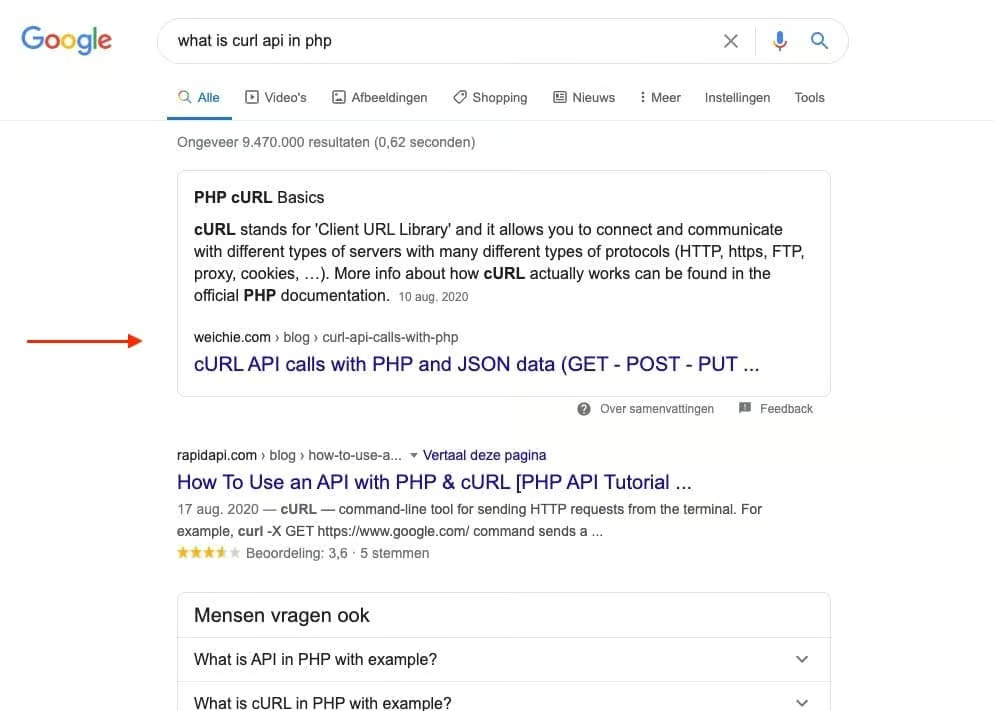
Position Zero, as shown in the image below, no longer exists. But we’ll keep it here to preserve some nostalgia for classic SEO from the past.
Now that you have the basics of SEO down and know what SEO means, you are ready to start your search for the best SEO company for your business.
Why work with an SEO company?
As a business, you are rarely the only provider of a service or product. Even with the best product on the market, you are invisible without a good position in Google. SEO companies can help with that.
Investing in SEO marketing is a big decision that can improve your website and save you time, but it can also do damage if it is not handled properly. Look into both the benefits and the possible damage of irresponsible SEO.
A good SEO company offers more than just copywriting, backlinks, and keyword research. What matters most: an agency that does not bet everything on one specific topic, such as content only, backlink networks only, or the technical side only.
1. How can SEO help your business?
The main reason for a website is to help people. You offer services or products, explain something, teach your visitors something new, or entertain them.
When you post something on social media or upload a video to YouTube, you want as much interaction as possible. The same goes for your website. If you offer the best chairs, everyone should know about it.
SEO helps people find what they need. If someone searches for a comfortable chair and your chair does not show up in the results, you miss a sale and your competitor wins. Every search has a specific intent. Does the user want to buy something, or mainly gather information?
It is important to know how people search for the products or services you offer. The power of SEO is offering the right content to the right users. Someone searching in French wants to see French results.
On the other hand: showing up in the search results for services you do not offer misleads visitors. Those are bad SEO practices.

2. Do you need a professional website?
A strong website can become the digital engine of your business, and it is often the first thing people see of you. Do you need a professional website for SEO? Not necessarily, but a slow, non-mobile-friendly website scores badly in SEO.
A professional SEO company often starts by improving your website. We also offer SEO Kickstarters that bring your site up to modern SEO standards, or an SEO audit that gives you more insight.
Although keyword research and competitor analysis are important, you need a solid foundation. SEO is a slow and steady process. Want to rank higher in Google? First take a critical look at your current website:
- Does it load quickly and does is score well on Core Web Vitals (loading speed, interactivity, visual stability)?
- Is your website responsive?
- Does your content match your target keywords?
- Is it user-friendly and well-structured?
- Do you have referrals to and from other websites?
- Are you using title & meta tags?
- Is it clear who is behind the website and why they are trustworthy (what Google calls E-E-A-T: experience, expertise, authoritativeness, and trust)?
- Are all images on the website optimized?
- Is your website secure?
Search engines approach your website differently than human visitors do. They want to offer the best user experience. A slow or heavy website makes SEO harder.
You can spend a lot of money on a marketing or SEO agency for your current website, but that is harder and takes more time to maintain. Start with a solid foundation to make the process easier and improve your website. Win-win.
3. SEO for a local business
People are often looking for something nearby. Do you search for “the best restaurant” or “the best restaurant near me”? Many people search with keywords like “nearby,” “in Brussels,” or “in my area.” Search engines automatically push results close to your current location. Weichie.com also optimizes websites specifically in the hospitality sector.
If you google “best SEO agency,” you get different results in New York than in Brussels, because Google knows you are looking for a local business. (Weichie.com is based in both New York and Brussels.)
Local SEO is crucial for your SEO strategy. People search constantly on their phones, and AI assistants such as ChatGPT, Gemini, and Perplexity also give location-based answers when someone asks for “a good physical therapist in Mechelen.” Those answers partly come from the same sources: your website, your Google Business Profile, and what other sites write about you.
A few tips for local SEO:
- Use local landing pages to highlight your services for specific areas.
- Use correct addresses, contact details, and opening hours, the same everywhere.
- Make use of Google Maps and Google Business Profile.
Important: make sure you have a well-functioning mobile website for local SEO.

4. SEO for large companies
Enterprise SEO adds a whole new level of complexity to SEO. It can even be a little overwhelming for smaller companies that have to compete against it. The competition in those areas is staggering. Looking for an SEO partner at this level? Look for an SEO company that is passionate and lives for those challenges. (hint hint)
Enterprise SEO usually competes for the most expensive keywords out there. Those keywords have both a high search volume and a high value. Examples are keywords with buying intent, and every internet giant wants them. Think Amazon, Bol.com, and Wikipedia. If you have to take on these players, you will not get there with a few blog posts or a product description that turns green in Yoast.
Good SEO companies monitor the status of your website and constantly adjust their strategy. They track impact versus effort and work fluidly with your marketing team.
It is very important that the SEO company you choose fits your business perfectly. Being on the same page, fast and clear communication, specific needs or goals, and a clear Request For Proposal (RFP): that is how you are 100% sure before you commit to an SEO partner.
5. Setting up multiple languages for good SEO
A multilingual website sounds simple to do, but we keep seeing the same mistakes come back. In New York, a multilingual site is something rare. But here in Brussels, or Belgium in general, almost every website we build has to be multilingual. Most companies think it is simply a matter of translating the content from Dutch to French or English. But by doing only that, you do more harm than good (for SEO purposes). You quickly end up with mixed content from different languages.
As mentioned at the start: a solid foundation makes your company’s SEO adventure considerably easier. Translations belong in that solid foundation. It is not just the content that needs translating.
Make sure you translate the following elements as well:
- All titles and text (obviously)
- The page URL and internal links on your website
- Categories and tags with their slug
- Meta titles and descriptions
- Images (the image name & alt-text)
- Forms, buttons, emails, thank-you pages, …
- Use correct canonical href-lang tags
- Publish a language only when it’s completely translated
- Use language directories and NOT subdomains (golden tip #2)
You may have noticed already, but this article with SEO tips looks like a checklist for a good website. By improving your SEO, you directly improve your website too, and vice versa. A decent SEO company makes sure the translations on your website are handled the right way.
A golden tip: do not automatically redirect users to a translated version of your website based on their browser language. It looks tempting and user-friendly, but it makes it harder for Google to index all the language versions of your site, especially if not all your content is available in every language.
Search engines are smart. If you have a page in English and in Dutch, Google automatically presents the language version it thinks fits the user best, depending on keyword, location, and probably other parameters as well.
Another golden tip: do not use subdomains for your translations. You split your visitors across multiple domains, and external backlinks have to choose which domain they link to. If three French websites link to your French page and five other sites link to your Dutch version, your backlinks get split, while those are eight full-fledged links to your website. So preferably never use subdomains for translations or online stores.
6. Google Business Profile (GBP)
Google My Business is now called Google Business Profile (GBP), but the idea is the same. It is a great off-page SEO technique and a must-have, even if you do not want to do anything else about SEO. Have you not set it up for your business yet? Create a Google Business Profile now. Then you can calmly return to this article.
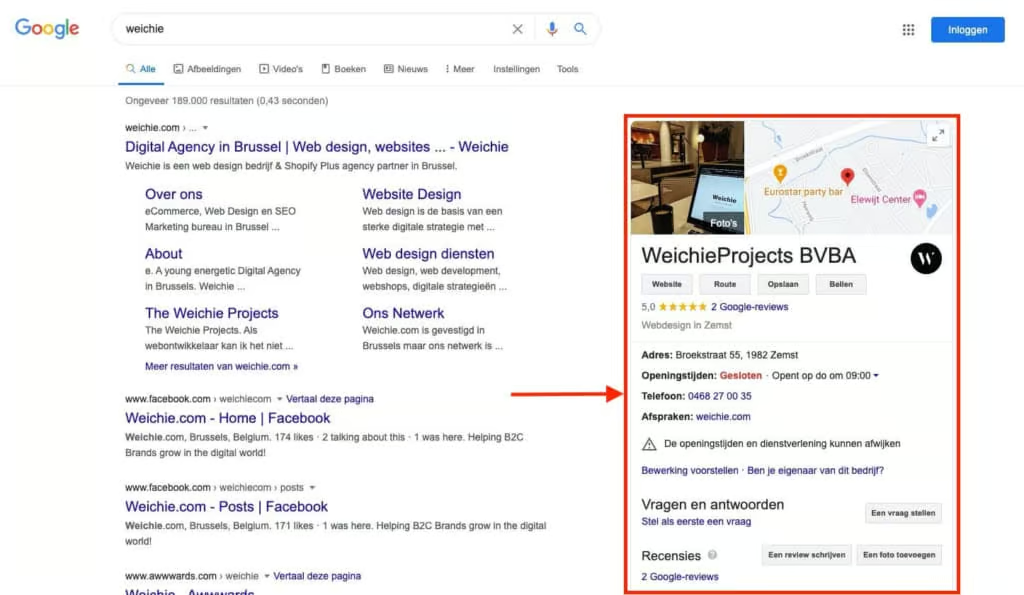
When people search directly for your business name in Google, they see a business card for your company on the right side of the search results. It offers all the essential information right away: name, address, contact details, opening hours, and customer reviews. We strongly recommend claiming your Google Business Profile as soon as possible.
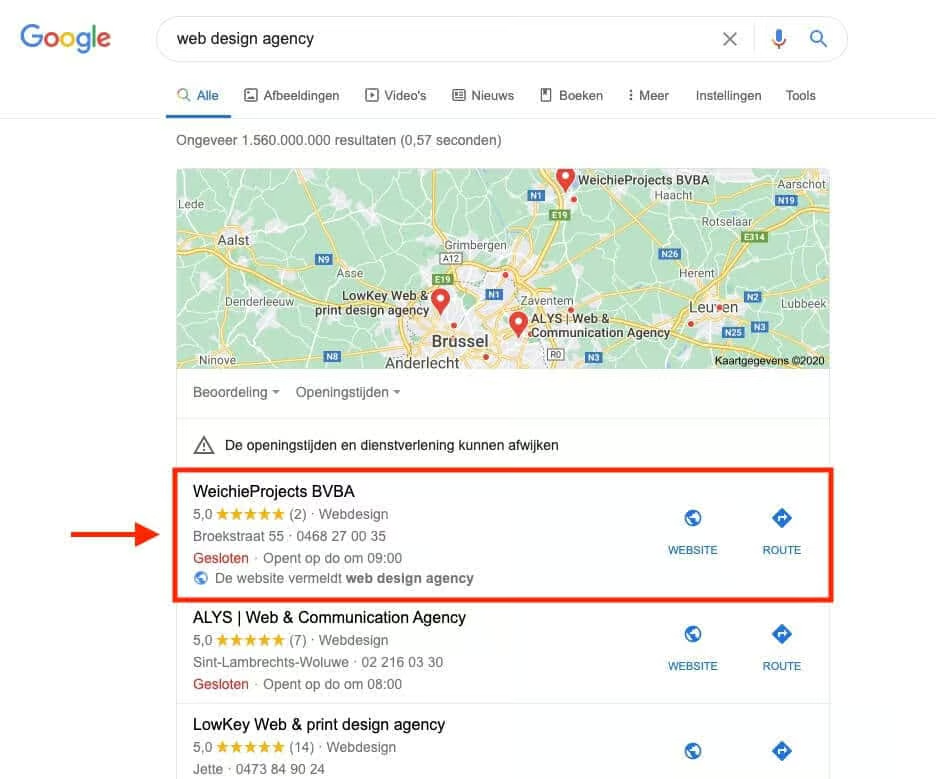
If you claim your business on Google Business Profile, it is also automatically marked on Google Maps. Another great win-win and off-page SEO technique. When your business is on Google Maps, it gets recommended in the search results when people near your location search for your services. You do not have to do anything extra for that. AI assistants also pull address, opening hours, and reviews largely from these kinds of profiles, so a correct and complete profile works on two fronts at once.
Do not forget Apple Business Connect either, the counterpart for Apple Maps. People use that app just as much to search.
7. Choosing the best SEO company for your business
Here we are at last. The most important question, and probably the reason you are reading this article. How do you find the best SEO company for your business? Before you can decide whether a company is good or bad at SEO, you first need a basic understanding of what SEO actually is and how it works. That is why we explained the basics in the six topics above.
Even if you have no time yourself and simply want to hire an SEO company to sort this out, spend a little time on some SEO research anyway. Otherwise the SEO company you work with can easily quote high prices for what you get in return. Now that you know the basics of SEO, you can start negotiating and comparing all the different SEO companies.
SEO is a long, slow but steady process. Besides the technical aspects, make sure you can see yourself working with this company for the long term. You need a good match with your SEO company, and flawless communication and planning.
Make sure you have a clear goal in mind before you walk into the meeting room. That way, the SEO company has to come up with a draft SEO game plan so you can see whether it fits your needs and workflow.
Important questions here: how will the SEO campaign be set up, how will the results be presented, which SEO techniques will they use (off-page, on-page, link building), how long will the campaign run, how intense will the follow-up be, how do they handle AI search (more on that in the next point), and of course: what is the price tag?
It is also important to know what happens if you decide to end the SEO partnership. Because SEO campaigns, unlike marketing campaigns, take time to set up, they also take time to wind down.

8. SEO in the age of AI: what you need to know about GEO
Alongside Google, ChatGPT, Gemini, Perplexity, and Google’s own AI Mode increasingly answer the questions that used to produce a list of blue links. Being visible in those answers now has a name: GEO, or Generative Engine Optimization. It resembles SEO, but it works fundamentally differently on a few points. As a studio, we actively research this ourselves, using crawl data and server logs from websites we build. We will soon publish an in-depth article on it.
What we see so far:
AI crawlers read your site differently than Googlebot. Google follows the URLs you offer through your sitemap and internal links. AI systems regularly guess URLs based on patterns: they see /services/web-design and try /services/seo, even if that page does not exist. The result is a stream of 404s that Search Console never shows you, because Google never requested those URLs. The right response is a 301 redirect to the page that does exist, not renaming your URL structure.
You measure GEO as presence, not position. An AI answer has no position 1 to 10, and the same question does not produce the same answer every time. What you can measure: how often your website shows up as a source across a series of repeated, relevant questions. You track that percentage over time, just like you used to track your rankings.
Rendering and indexing remain the foundation. An AI system does not cite a page it cannot read. Sites that load slowly, only show their content through JavaScript, or are poorly indexed disappear from AI answers just as hard as from Google. Everything in point 2 of this article counts double here.
Structure and clarity win. Clear headings, direct answers to concrete questions, structured data, and a clear sender help a language model understand your content and feel confident enough to cite it. Vague marketing copy is rarely picked up.
The question to ask every SEO company: “How do you measure whether we appear in AI answers, and what do you do about it?” An agency that has no answer to that yet is not up to speed. That is not a cardinal sin, but it is something to know before you sign a long-term contract.
9. Boosting your results with SEA (optional)
Many people choose SEO, or SEA (Search Engine Advertising), or Social Media Advertising. SEA is the perfect choice if you launch landing pages for the short term and want to reach as many people as possible in a short time.
If you are in it for the long term, we recommend thinking twice and first giving an SEO approach the benefit of the doubt. Sure, with Google Ads you get immediate results, but as soon as the campaign is over, your website loses all its progress. It never ranked first in Google, you simply paid for the top spot. An ad usually sits above the organic search results, however much you invest in SEO. That spot is no longer exclusive, though: for more and more searches, an AI Overview sits at the top as well, and you cannot buy your way in there, only earn it by being cited well.
Both SEO and SEA require in-depth keyword research and competitor analysis. Much of that research phase can be used for both the SEA campaigns and the SEO game plan. That slightly larger investment usually delivers the biggest ROI (return on investment).
For short-term projects, however, there is no point in doing SEO. By the time Google includes your page in the search results, the event is probably long over.
Conclusion
When you invest in SEO, you invest in your website at the same time, because SEO will challenge the technical aspects of the website, such as loading time and image optimization. Make sure the SEO company you choose is not just about marketing and writing as much content as possible, but also has great in-house developers to improve the website, and understands how both Google and AI systems read that website.
Be committed to implementing the recommended changes. SEO takes time and effort. If you do not take the time to make those changes, it is not worth hiring an SEO expert.
Interview the potential SEO company. Can they share previous work or success stories with you? Do they follow the guidelines of Google Search Console and the Search Essentials? How long have they been in business, what are their main SEO techniques, are they truly interested in your business (honest research into your customers and competitors)?
Ask for a technical and content audit. Do not immediately hire the first one you come across. Ask for a good strategy and website audit up front. The SEO company should know what they are going to do and what they can best do to help your website rank in Google. Every agency has its own strategy. Hire someone whose strategy best fits your business goals.
Decide whether you actually want to hire someone.
Feel free to get in touch if you are looking for a new SEO company. We would like to hear what you have in mind and work out the best possible SEO game plan for your business together.
Curious whether your website is ready for SEO and AI search? Request an SEO audit and we will look together at what is good, and less good, about your current website.
Talk soon!